Winston County Dog Registration Information
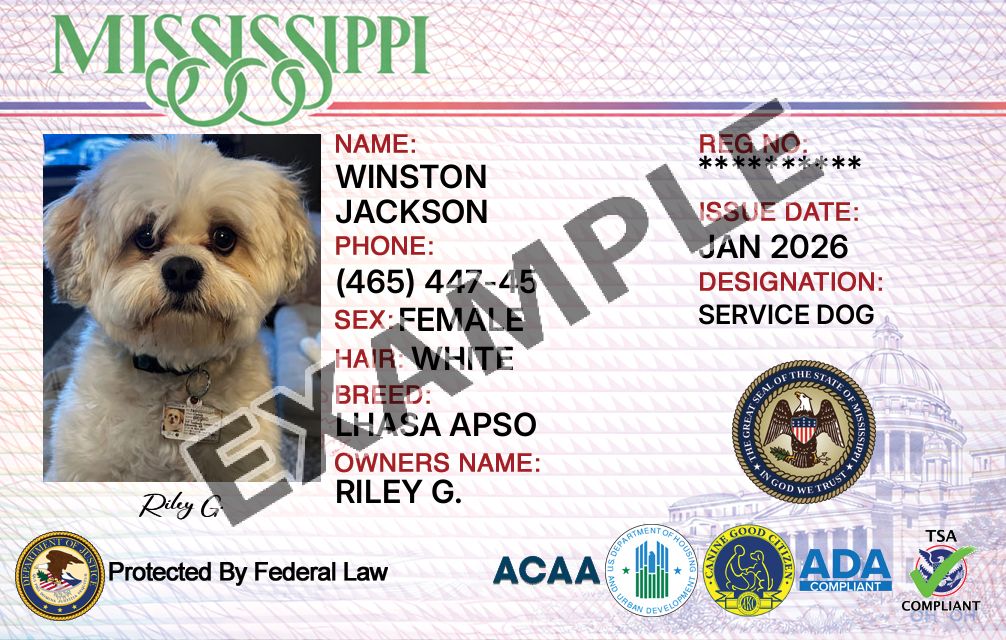
Service Dogs and Emotional Support Animals in Winston, Mississippi
If you’re searching where do I register my dog in Winston County, Mississippi for my service dog or emotional support dog, the key thing to know is that “registration” can mean different things. In most cases, what people really need is (1) a dog license in Winston County, Mississippi (when required by a city or local ordinance), and/or (2) proof of a current rabies vaccination, and/or (3) the correct understanding of service dog legal status or emotional support animal (ESA) rules.
Winston County dog licensing and enforcement is typically handled locally (county or city). That’s why the best place to start is with local government offices (city hall, law enforcement/animal control contacts, and the county health department for rabies and bite/exposure guidance).
Where to Register or License Your Dog in Winston County, Mississippi
Because dog licensing and enforcement can be handled at the city level and/or through local law enforcement, below are example official offices within Winston County that residents commonly contact for where to register a dog in Winston County, Mississippi, rabies documentation questions, and animal control dog license Winston County, Mississippi enforcement concerns. If an item (like hours or email) is not publicly listed in an official directory, it’s left blank rather than guessed.
County Public Health (Rabies & Exposure Guidance)
Winston County Health Department
- Address: 95 Vance St
- City/State/ZIP: Louisville, MS 39339-3140
- Phone: (662) 841-9015
- Email: Not publicly listed in the referenced directory
- Office hours: Not publicly listed in the referenced directory
Use this office for guidance after bites/exposures and to understand local rabies control expectations. Rabies vaccination itself is administered by veterinarians, but public health often coordinates exposure response.
- Rabies exposure questions
- Bite reporting guidance
- Rabies compliance expectations
County Law Enforcement (Local Enforcement / Animal-Related Complaints)
Winston County Sheriff’s Office (Winston County Annex/Courthouse Area)
- Address: 148 S Court Ave
- City/State/ZIP: Louisville, MS 39339
- Phone: (662) 773-5881
- Email: Not publicly listed in the referenced source
- Office hours: Not publicly listed in the referenced source
If Winston County does not operate a standalone county animal control department, the sheriff’s office is often a practical starting point to ask who handles animal control calls and whether any county-level dog licensing applies.
- Dog-at-large complaints
- Bite reports and next steps
- Who issues citations (if any)
- Whether licensing is city-only
City-Level Starting Point (If You Live Inside City Limits)
Louisville City Hall
- Address: 200 S Church Ave
- City/State/ZIP: Louisville, MS 39339
- Phone: (662) 773-9201
- Email: Not publicly listed in the referenced source
- Office hours: Not publicly listed in the referenced source
If you live in Louisville city limits, city hall can tell you whether the city requires a local license tag/permit, how rabies compliance is enforced, and which department administers animal control.
- “Do you require a city dog license tag?”
- “Who is animal control for my neighborhood?”
- “What proof do you require (rabies, ID)?”
If You Live Outside Louisville City Limits
Many residents in unincorporated areas won’t have a “city hall” license process. In that case, your best starting points are the Winston County Sheriff’s Office (to identify who handles enforcement) and the Winston County Health Department (for rabies/exposure protocols).
Overview of Dog Licensing in Winston County, Mississippi
What “Registering Your Dog” Usually Means
In everyday conversation, “registering” a dog can mean one (or more) of the following:
- Local dog license tag/permit (if required by a city ordinance or local rule).
- Rabies vaccination compliance (keeping a current rabies certificate and any tag your veterinarian provides).
- Animal control records (for example, records tied to bites, quarantines, or nuisance complaints).
- Service dog or ESA status (which is not the same as a dog license and usually is not handled through county licensing offices).
Rabies Vaccination Is a Core Requirement
Mississippi law requires rabies vaccination for dogs and cats starting at three (3) months of age, and vaccination should be kept current. After vaccination, the administering professional should provide a rabies vaccination certificate (and often a rabies tag). Local offices and animal control enforcement commonly rely on that proof when responding to bite reports or dog-at-large complaints.
Licensing vs. Rabies Proof
A dog license in Winston County, Mississippi (if applicable in your city) is typically a local permit or tag that helps local government identify owned dogs and encourage vaccination compliance. Rabies proof, however, is a health and public safety requirement and may be requested whether or not your specific town issues a separate dog license tag.
How Dog Licensing Works Locally in Winston County, Mississippi
Step-by-Step: How to Find the Right Licensing Office for Your Address
- Confirm whether you live inside city limits (for example, Louisville). City ordinances may apply only within the municipality.
-
Call the most local office first:
- If inside Louisville: start with Louisville City Hall.
- If outside city limits: start with the Winston County Sheriff’s Office to ask who handles animal control and whether any county licensing applies.
- Ask what “license” means in your area. Some places issue a physical tag; others focus on rabies compliance and complaint response without a yearly license program.
- Prepare your proof documents (rabies certificate, ID, proof of residency) and ask about any fees if a local license is issued.
Rabies Enforcement, Bites, and Quarantine Questions
If your questions involve a bite, potential rabies exposure, or quarantine requirements, contact the Winston County Health Department. Public health offices can explain local procedures and what documentation (such as a rabies certificate) you may need to provide.
Common Outcomes When You Call
Outcome A: City Issues Licenses
If your municipality issues a license tag, you’ll be told where to apply, what it costs, and what proof is required (typically rabies vaccination proof).
Outcome B: No Separate License Program
If there is no separate license process for your area, you’ll likely be instructed to keep rabies vaccination current and follow local leash/at-large rules, with enforcement handled through local authorities when complaints occur.
Service Dog Laws in Winston County, Mississippi
Service Dogs: Legal Status Is Not the Same as a Dog License
A service dog’s status comes from what the dog does—being individually trained to perform tasks or work for a person with a disability—not from being placed on a county list. That means:
- You generally do not “register” a service dog with a county office to make it a service dog.
- A local animal control dog license Winston County, Mississippi requirement (if one applies) is usually about rabies compliance and local identification—not disability access rights.
- Even if a local license is required, it applies because the dog lives in the community (not because it is a service dog).
Public Access Basics (Practical Expectations)
While local offices handle licensing and rabies issues, public access questions usually come up in daily life (stores, restaurants, public buildings). In practice:
- A service dog should be under control and housebroken.
- Businesses commonly focus on behavior and control, not “registration papers.”
- Keeping rabies vaccination proof current is still important for compliance and safety.
What to Do Locally in Winston County
If you’re trying to be fully compliant in Winston County, your checklist is usually:
- Keep rabies vaccination current and keep the certificate in your records.
- Follow local leash/at-large rules for your city or area.
- If your city issues a license, obtain/renew it like any other dog owner (unless the city has a specific exemption—ask city hall directly).
Emotional Support Animal Rules in Winston County, Mississippi
ESAs Are Not Service Dogs
An emotional support animal provides comfort by its presence, but it is not the same as a trained service dog that performs disability-related tasks. Because of that difference:
- An ESA generally does not have the same public-access rights as a service dog.
- ESA issues are most often related to housing requests rather than dog licensing offices.
- A local dog license process (if any) is still about local animal rules, not ESA recognition.
Housing vs. Licensing
If your goal is to live with an ESA in housing that has pet restrictions, you typically address that with the housing provider (and keep your animal compliant with local rules). Separately, you still may need to comply with:
- Rabies vaccination requirements
- Leash/at-large ordinances
- Any local licensing or tag rules in your city
What Winston County Offices Can (and Can’t) Do for ESAs
Local government offices can usually help with animal ordinance questions and rabies/exposure protocols. They typically do not issue an “ESA registration” that creates rights. If someone is offering to “register” your ESA for a fee, treat that as a third-party product rather than an official requirement.
Frequently Asked Questions
Register A Dog In Other Mississippi Counties
Select your county below to get started with your dog’s ID card. Requirements and license designs may vary by county, so choose your location to see the correct options and complete your pup’s registration.
- Adams County Dog Registration
- Alcorn County Dog Registration
- Amite County Dog Registration
- Attala County Dog Registration
- Benton County Dog Registration
- Bolivar County Dog Registration
- Calhoun County Dog Registration
- Carroll County Dog Registration
- Chickasaw County Dog Registration
- Choctaw County Dog Registration
- Claiborne County Dog Registration
- Clarke County Dog Registration
- Clay County Dog Registration
- Coahoma County Dog Registration
- Copiah County Dog Registration
- Covington County Dog Registration
- DeSoto County Dog Registration
- Forrest County Dog Registration
- Franklin County Dog Registration
- George County Dog Registration
- Greene County Dog Registration
- Grenada County Dog Registration
- Hancock County Dog Registration
- Harrison County Dog Registration
- Hinds County Dog Registration
- Holmes County Dog Registration
- Humphreys County Dog Registration
- Issaquena County Dog Registration
- Itawamba County Dog Registration
- Jackson County Dog Registration
- Jasper County Dog Registration
- Jefferson County Dog Registration
- Jefferson Davis County Dog Registration
- Jones County Dog Registration
- Kemper County Dog Registration
- Lafayette County Dog Registration
- Lamar County Dog Registration
- Lauderdale County Dog Registration
- Lawrence County Dog Registration
- Leake County Dog Registration
- Lee County Dog Registration
- Leflore County Dog Registration
- Lincoln County Dog Registration
- Lowndes County Dog Registration
- Madison County Dog Registration
- Marion County Dog Registration
- Marshall County Dog Registration
- Monroe County Dog Registration
- Montgomery County Dog Registration
- Neshoba County Dog Registration
- Newton County Dog Registration
- Noxubee County Dog Registration
- Oktibbeha County Dog Registration
- Panola County Dog Registration
- Pearl River County Dog Registration
- Perry County Dog Registration
- Pike County Dog Registration
- Pontotoc County Dog Registration
- Prentiss County Dog Registration
- Quitman County Dog Registration
- Rankin County Dog Registration
- Scott County Dog Registration
- Sharkey County Dog Registration
- Simpson County Dog Registration
- Smith County Dog Registration
- Stone County Dog Registration
- Sunflower County Dog Registration
- Tallahatchie County Dog Registration
- Tate County Dog Registration
- Tippah County Dog Registration
- Tishomingo County Dog Registration
- Tunica County Dog Registration
- Union County Dog Registration
- Walthall County Dog Registration
- Warren County Dog Registration
- Washington County Dog Registration
- Wayne County Dog Registration
- Webster County Dog Registration
- Wilkinson County Dog Registration
- Yalobusha County Dog Registration
- Yazoo County Dog Registration